
Build a Simple AI Agent in Python
Think AI agents are too complex for you? Not anymore. By October 2026, you can build a simple AI agent in Python, and it’s easier than you…
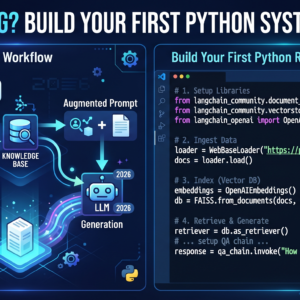
What is Retrieval-Augmented Generation (RAG)? Build Your First Python System in 2026
Is your LLM hallucinating more than a desert traveler? Are its answers outdated faster than your news feed? In 2026, relying solely on a large language model’s…
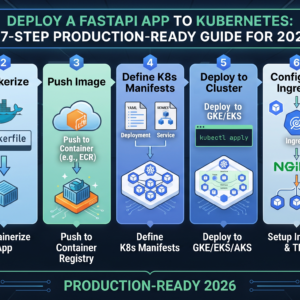
Deploy a FastAPI App to Kubernetes: A 7-Step Production-Ready Guide for 2026
Alright, let’s be real. If you’re building APIs with FastAPI in 2026, you’re doing it for speed, right? And if you’re deploying anything serious, you’re probably wrestling…
Modern Backend Architecture: FastAPI, Docker, and Cloud Deployment Explained
Introduction: Why Modern Backend Systems Must Be Scalable by Design In today’s software landscape, scalability is no longer a luxury — it’s a basic expectation. Applications must…
CI/CD Pipeline
A CI/CD pipeline coordinates all the processes involved in continuous integration and continuous delivery. Continuous integration (CI) is the practice of automating the integration of code changes…
Docker Volume
In Docker, volumes are the preferred mechanism for persisting data generated by and used by Docker containers. They provide a way to store data outside of the container’s writable layer,…
Kubernetes
Kubernetes (also called K8s) is an open-source platform that helps you automates the deployment, scaling, and management of containerized applications. Kubernetes helps you organize and control them efficiently just like…
Docker
Docker is an open platform for developing, shipping, and running applications. Docker enables you to separate your applications from your infrastructure so you can deliver software quickly….
Docker Vs Kubernetes
Docker and Kubernetes are both crucial technologies for containerized applications, but they serve different purposes. Docker is a platform for building, sharing, and running containers, while Kubernetes is…
Count vectorization
Count Vectorization is a technique used in Natural Language Processing (NLP) to convert text into numerical feature vectors. It represents text data as a matrix where each…